The medical field is packed with names of diseases, syndromes, abnormalities, and tests named after the pioneers who discovered them (i.e., an eponym). Some eponyms are used on a regular basis, and require no explanation such as Asperger’s disorder or Alzheimer’s disease. In contrast, other eponyms are rarely used and send us rummaging through our nursing school memories in search of details. For example, how often do you hear about Balò’s disease? Well, there just may be an app for these situation – Eponyms.
The Eponyms app includes over 1,700 medical eponyms. The app organizes the eponyms in alphabetical order allowing for easy location. You may also use the search function to locate a specific eponym. This very extensive list covers all types of medical conditions and practice.
Once you locate the desired eponym, tap the name to view the details on the eponym.
You also have the option to star specific eponyms and create a specialized list of eponyms specific to your practice.
Overall, I found the app provided quick and easy access to information. Eponymsshould definitely be included in any nurse’s app arsenal.
Epocrates, an Athena Company, has a suite of products for clinicians. According to their site, they have over 1,000,000 active members and have assisted in adverting over 27,000,000 medication errors. This review focuses on their popular drug information system for clinicians, which is free of charge.
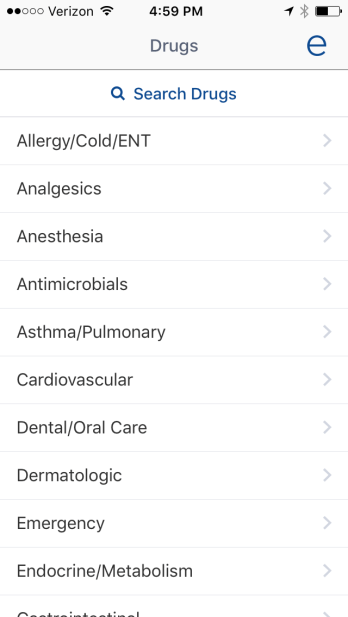
The app is easy to download and register, which allows access to the drug information. You can search for drugs by name or category.
Epocrates. (2017). Screenshot of drug search.
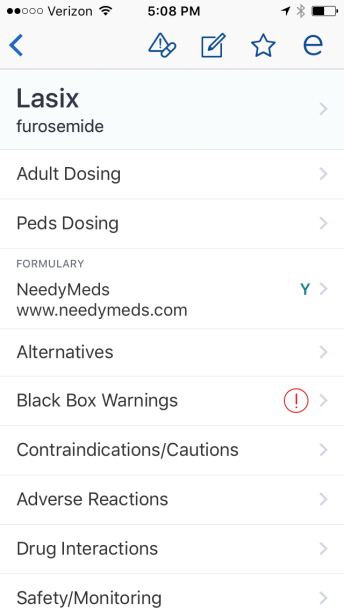
A name search allows quick access to the requested drug. The drug information is divided into well organized headings including- black box warnings, dosing, safety/monitoring, drug interactions, and so forth. Each section includes useful details for a clinician prescribing medications.
Epocrates. (2017). Lasix Screenshot .
Epocrates has done an excellent job on developing and including the most recent evidence-based practice to guide prescribing clinicians. Here is a video that discusses their process:
The information team includes highly qualified pharmacists and a physician. But, who is missing from the team? Nurses! According to this video, nurses are not included on the information team. This may explain why some of the necessary nursing elements addressing medication administration are missing from the drug information. For example, a review of lasix does not mention the slow administration of IV Lasix to prevent ototoxicity. Another example is IV amiodarone, used for life-threatening cardiac arrhythmias. When administering IV amiodarone, an in-line IV filter is necessary. However, this critical information is not included in the drug information.
Another concern revolves around the patient education information. The online version of Epocrates provides a very helpful section on patient education. This includes guidance on key information to discuss with the patient. However, the patient education element is missing from the mobile version.
Nurses serve in a variety of roles from bedside care to visiting patients in their homes, and need quick access to comprehensive drug information to ensure the best possible patient outcomes. The prescribing of medications is important, but the administration is equally as important. Epocrates drug app does provide great prescribing drug guidance; but, is missing the nursing perspective including information on drug administration. Also, all nurses involved in patient education need access to patient education materials, not just those with Internet access via a laptop or desktop computer. So, if you are a nurse looking for a drug app to guide the administration of medications or patient education, this may not be the best available option.



 Epocrates. (2017). Lasix Screenshot .
 The App Nurse